Opinion | San Francisco Politics
Billionaire Ballot Blitz: Big Money Targets June Election
Money Goes In. Favors Come Out
Editor’s Note: Opinions expressed by contributors to the Westside Observer are the author’s point of view. They do not reflect the position of WSO. As always, we welcome opposing commentary submissions.

Monette-Shaw
• • • • • • • • • • May 2026 • • • • • • • • • •
San Francisco’s June 2 election is drawing heavy spending from billionaires funding “independent” committees like GrowSF and Neighbors for a Better San Francisco. Voters should remain wary: money in often means favors out.
A group of billionaires—including Michael Moritz, Chris Larsen, Bill Oberndorf, and Gary Tan, along with Mayor Daniel Lurie as an heir to a billionaire family—appear to believe San Francisco’s June 2 and November 3 elections are for sale. They are channeling millions into so-called independent expenditure committees, most notably GrowSF and Neighbors for a Better San Francisco.
San Franciscans know their elections are not for sale. They belong to the people—and, one hopes, voters will not be fooled again.

Elections aren’t supposed to be auctions—but that’s what this is starting to look like.”
Follow the Money: Billionaire Spending Looms Over June 2 Vote
The June 2 primary ballot contains just four measures—one of the shortest ballots in recent memory.
Proposition A: “Earthquake Safety” or Something Else?
Formally titled the Earthquake Safety and Emergency Response bond, Proposition A is a $535 million general obligation bond that raises serious concerns.
The bond’s legal text lists broad spending categories but does not identify specific projects. This omission is critical. Under CEQA, the California Environmental Quality Act, projects without defined scope can avoid environmental review. Section 14 of the voter guide states that no CEQA review is required because the bond does not commit to named projects.
This creates a built-in Catch-22: by not naming projects, they can avoid environmental review, leaving decisions to be made only after voters approve the bond.
Equally concerning is what the bond does not include. There is no funding to restore San Francisco’s Outdoor Public Warning Siren system—a key emergency tool that has been offline since 2019. That omission alone raises questions about the measure’s priorities.
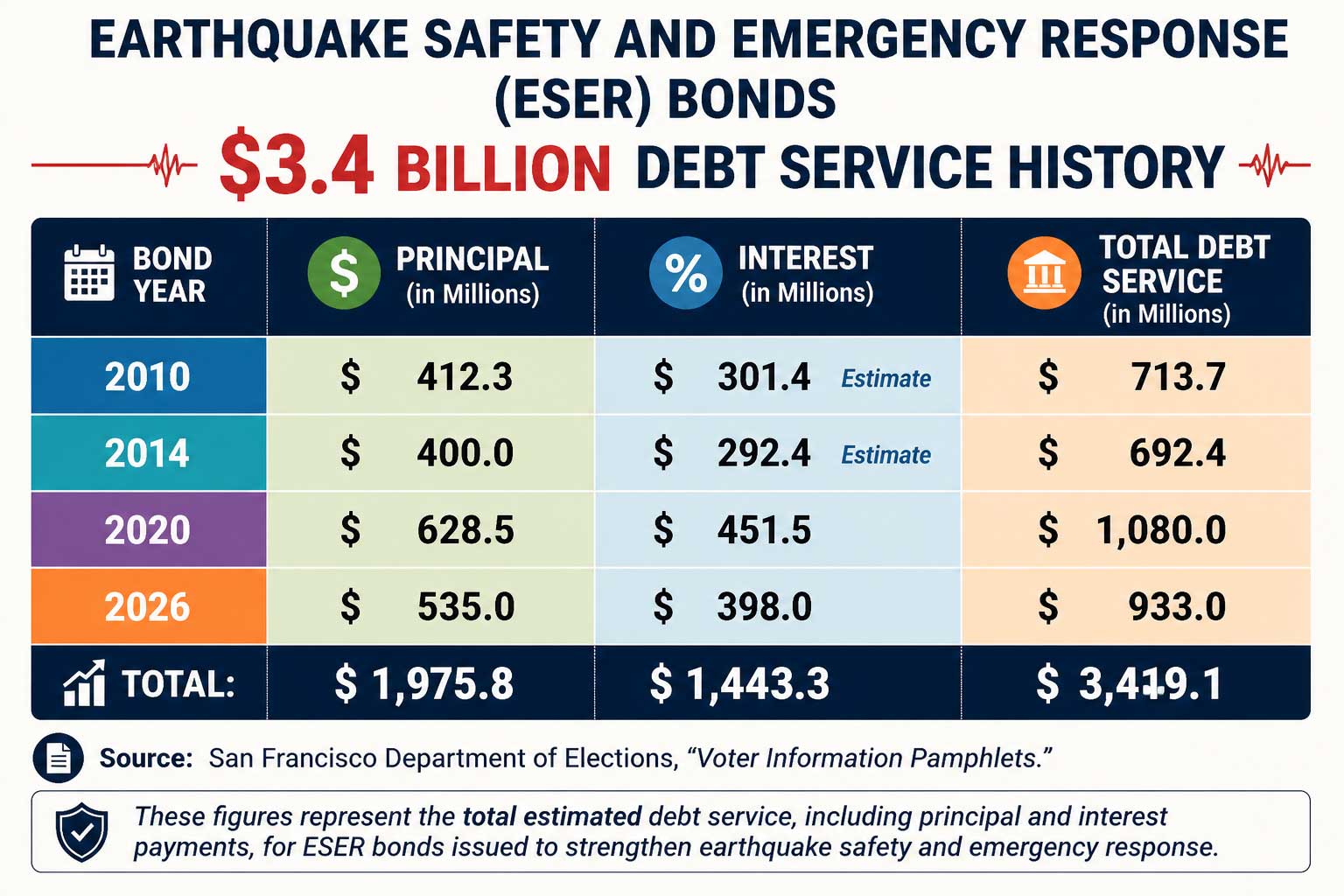
Financially, Proposition A continues a troubling pattern. If approved, total ESER bond debt since 2010 would reach approximately $3.42 billion, including interest. Yet only a fraction has gone toward firefighting water infrastructure.
No named projects, no CEQA review, no accountability—that’s the deal voters are being asked to accept. A bond with no project list isn’t transparency—it’s a blank check.”
Analysis shows that just $130 million—about 24.3%—of the 2026 bond would be allocated to the Emergency Firefighting Water System and the high-pressure Auxiliary Water Supply System. The remaining $405 million, or 75.7%, would fund projects with limited connection to earthquake safety, including $205 million for public safety facilities and $200 million for the MUNI Potrero Yard bus storage facility, which voters previously rejected.
Even these figures may be overstated. Prior bonds have included issuance and oversight costs averaging $7.74 million, which are not clearly disclosed in the current proposal.
Looking back, voters approved $1.44 billion in ESER bonds over the past 16 years. Of that, only $309.6 million, or 21.4%, went toward emergency firefighting water systems. The majority funded facilities such as police stations, firehouses and other buildings.
Water engineer Heather Davies warns (Page 43) that Proposition A prioritizes lower-pressure water systems over the high-pressure infrastructure needed for firefighting. She also notes that the bond would initially fund fewer than five miles of pipeline, with full expansion not expected until after 2040. The total cost for Westside coverage alone could reach $5 billion, with interest potentially doubling that figure.
Davies also raises concerns about cybersecurity vulnerabilities, referencing the 2019 hack that shut down the Outdoor Public Warning Siren system. She disputes claims that the bond will strengthen high-pressure systems, arguing instead that it may increase risk.
The key question for voters: who should be believed—political leaders backed by billionaire-funded campaigns, or technical experts raising concerns?”
Additional criticism comes from Westside Observer contributors. George Wooding argued that Proposition A resembles a slush fund rather than a targeted public safety measure, lacking transparency and accountability. John Crabtree highlighted discrepancies between campaign claims and the bond’s legal text, noting that promises of expanded hydrants and high-pressure water lines are not included.
Crabtree further reports that since 2010, not a single Auxiliary Water Supply System hydrant has been installed in 15 underserved Westside neighborhoods. Despite repeated promises, the ESER bond program has failed to deliver meaningful expansion of high-pressure firefighting infrastructure.
Until City Hall provides a clear and credible plan, voters have strong reasons to reject Proposition A and demand a better measure in November.
Author’s Recommendation
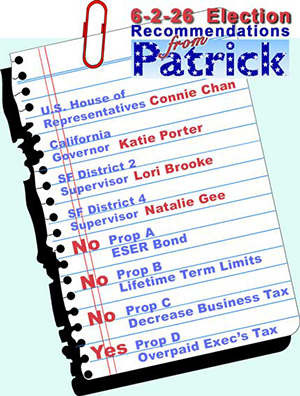
Vote “No” on Proposition A.
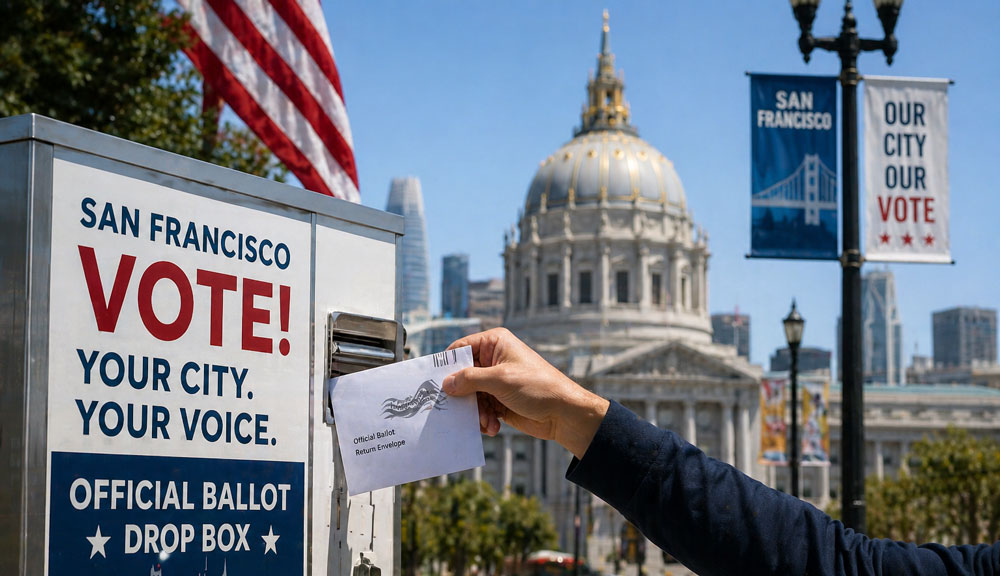
San Francisco’s Ballot for Sale? Billionaire Cash Floods June Election
Proposition B: A Solution in Search of a Problem
Proposition B would impose lifetime term limits on the mayor and members of the Board of Supervisors.
Supporters claim it ensures turnover in leadership. Critics argue it is unnecessary and anti-democratic.
The measure was introduced by Supervisor Bilal Mahmood and placed on the ballot by a 7–4 vote of the Board of Supervisors. It is backed by the same billionaire-funded networks supporting other measures.
Opposition is broad. Former mayors Willie Brown and Art Agnos, former state and local officials, and former Governor Jerry Brown have all criticized the measure. The San Francisco Chronicle editorial board recommends a “No” vote, calling it insider-driven and unnecessary.
The measure contains inconsistencies. It includes carve-outs allowing certain current supervisors to complete additional terms while excluding other elected offices—such as District Attorney and City Attorney—from lifetime limits entirely.
Term limits already exist—this isn’t reform, it’s restriction..”
San Francisco’s current term limits have functioned effectively for decades. Only one official in over 30 years has returned after the required break between terms.
Lifetime bans would reduce voter choice without addressing a clear problem. Elections—not rigid restrictions—should determine who serves.
Author’s Recommendation
Vote “No” on Proposition B.
Money In, Favors Out: Big Donors Dominate SF’s June Ballot
Proposition C: Tax Cuts with Consequences
Proposition C would increase the small business tax exemption threshold from $5 million to $7.5 million in gross receipts.
While framed as relief for small businesses, the measure would primarily benefit larger firms. According to the City Controller, it would reduce General Fund revenue by $30 million to $40 million annually.
The measure is heavily supported by business groups and billionaire donors. Its campaign committee, despite its name, is largely funded by individuals rather than grassroots organizations.
When tax breaks grow, public services shrink—that’s the math.”
More concerning is a provision that could override competing measures. If Proposition C receives more votes than Proposition D, it would nullify Proposition D entirely—even if both measures pass.
This “poison pill” could eliminate up to $300 million in potential revenue, compounding the financial impact of the tax reductions.
At a time when San Francisco faces ongoing budget deficits, such revenue losses raise serious concerns about fiscal stability.
Author’s Recommendation
Vote “No” on Proposition C.
Proposition D: Addressing Executive Pay Disparities
Proposition D would increase taxes on large corporations where executive compensation far exceeds that of average workers.
The measure applies only to companies with more than $1 billion in revenue, over 1,000 employees, and executive pay exceeding 100 times median worker salaries.
According to the City Controller, Proposition D could generate $250 million to $300 million annually.
Supporters argue it promotes fairness and helps offset budget shortfalls. They also note that similar measures in 2020 did not result in businesses leaving San Francisco.
At a time of deficits, doing nothing is also a choice.”
Opposition again comes from billionaire-backed groups, including those supporting Proposition C.
For voters, the contrast is clear: Proposition C reduces revenue, while Proposition D increases it by targeting the largest corporations.
Author’s Recommendation
Vote “Yes” on Proposition D.
High-Dollar Politics Hits Home: SF Voters Confront Billionaire Influence
Beyond ballot measures, several races are drawing heavy spending influenced by the U.S. Supreme Court’s Citizens United v. Federal Election Commission decision.
United States Representative, District 11
The race to replace Nancy Pelosi is a primary that will advance two candidates to a November runoff.
Saikat Chakrabarti has not held elected office and lacks legislative experience. State Senator Scott Wiener promotes his housing record, though critics argue his policies have benefited developers without producing significant housing in San Francisco.
Big endorsements don’t replace a track record.”
Supervisor Connie Chan, by contrast, has served as chair of the Board’s Budget Committee and is regarded as an effective legislator. Supporters argue she brings experience and fiscal discipline.
Author’s Recommendation
Vote for Connie Chan.
California Governor
The gubernatorial primary includes several high-profile candidates.
Billionaire Tom Steyer has invested heavily in his campaign but has never held elected office. Former Congresswoman Katie Porter offers extensive legislative experience and a strong reputation for consumer advocacy.
Porter’s campaign emphasizes accountability and economic fairness—issues central to many voters.
Money can launch a campaign—but it can’t substitute for governing.”
Author’s Recommendation
Vote for Katie Porter.
Board of Supervisors: District 2
Incumbent Stephen Sherrill is aligned with Mayor Lurie and backed by GrowSF. Critics argue his positions reflect the priorities of wealthy donors.
Challenger Lori Brooke offers an alternative for voters seeking independence from billionaire influence.
Author’s Recommendation
Vote for Lori Brooke.
Board of Supervisors: District 4
Incumbent Alan Wong, who was appointed rather than elected, faces criticism for aligning closely with the mayor and failing to deliver on key issues, including coastal safety and the Outdoor Public Warning System.
Challenger Natalie Gee brings legislative experience and strong labor support, including endorsements from major unions and community organizations.
Author’s Recommendation
Vote for Natalie Gee.
A Test for Voters
The June 2 election is more than routine—it is a test of whether San Franciscans will allow concentrated wealth to shape public policy.
Money can launch a campaign—but it can’t substitute for governing.”
Across ballot measures and candidate races, a consistent pattern emerges: significant spending by a small group of wealthy individuals seeking influence.
Voters face clear choices: reject measures lacking transparency and accountability; question proposals that reduce public revenue while benefiting private interests; and support candidates with demonstrated experience and independence.
San Francisco’s future should not be decided by campaign spending. It should be determined by informed voters exercising independent judgment.
Vote on or before June 2—and make it count.
Author note: Monette-Shaw is a columnist for San Francisco’s Westside Observer, a member of the California First Amendment Coalition and the ACLU, and operator of stopLHHdownsize.com.
Contact: monette-shaw@westsideobserver.com
Editors Note: This is a condensed version of Monette-Shaw’s article. The expanded article is also available.
May 2026