I’m Still Writing Letters to City Hall — Even If No One Is Listening
Access-Ramp Warfare
No all-out shooting, but skirmishes at every street corner.

• • • • • • • • July 2025 • • • • • • • •
Dear Mayor Lurie, Board of Supervisors President Mandelman, Supervisors, and City employees:
You may be tired of my emails about curb ramps and other disability access/disability rights issues regarding the public right-of-way. Be assured, I’m orders of magnitude more tired of having to send them
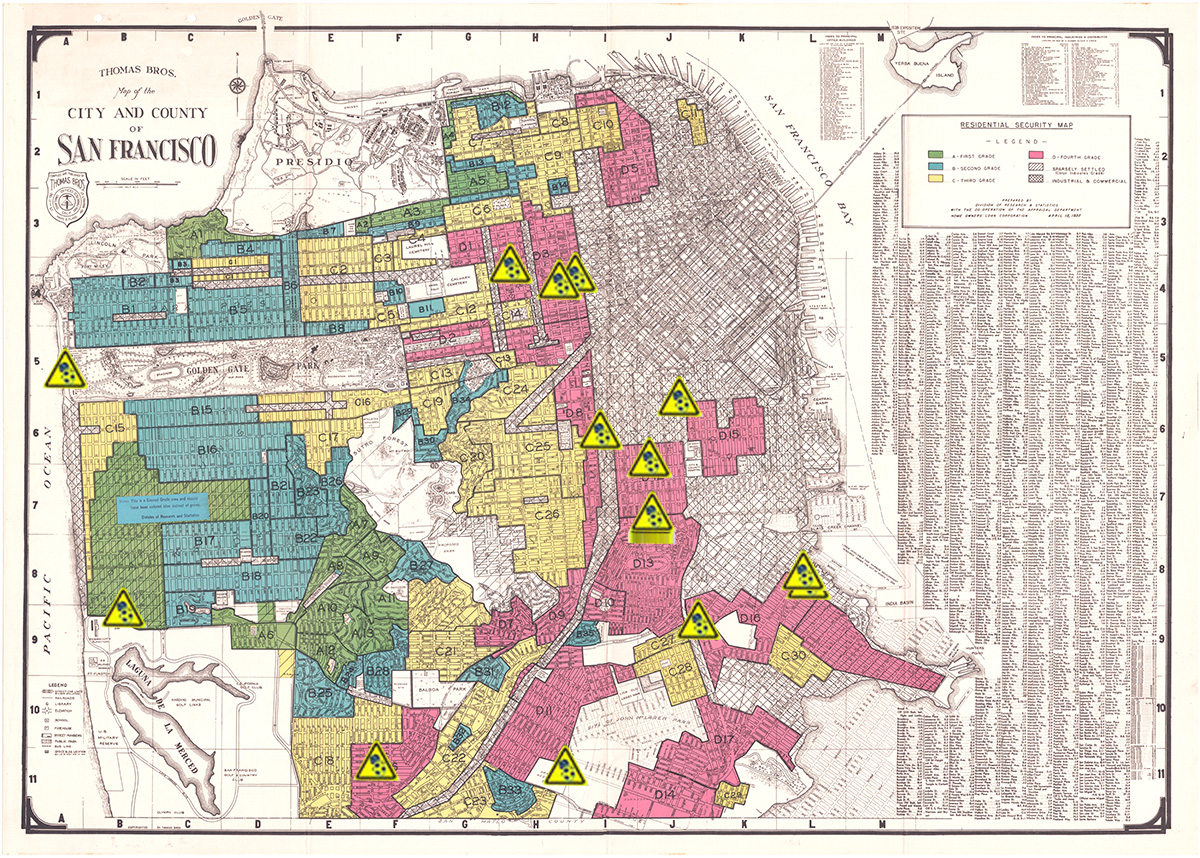
Half a Century. According to the most recent DPW Curb Ramp Fact Sheet/Dashboard (run date June 10, 2025), as of March 12, 2025, only 77 % of existing or potential locations in San Francisco had curb ramps in good condition. 6,209 buildable locations comprising 15% of buildable locations had no curb ramps at all (and never have had), 2,277 (5%) of existing curb ramps were in poor condition, and 1,209 (2%) were in fair condition. This is 33 years after the 1992 effective date of the Americans with Disabilities Act of 1990. At the rate of 1% to 2% progress per year for the past several years, as shown on the report, it would take an additional 11 to 23 years from 2025 to complete the remaining 23% of locations. In other words, an individual born in 1992 would be between 44 and 56 years old when all locations have curb ramps in good condition! Do you think that’s right?
Moreover, I don’t know how often curb ramps are inspected, but based on my frequent observations over many years, it’s quite likely there are more in poor or fair condition than stated in the report.

I was almost hit by a bus on July 6, 2018, because there was no curb ramp in the direction I was crossing at one of the corners mentioned...”
Per the report, the largest source of curb ramp construction and funding by far is the Street Resurfacing Program. The Curb Ramp Program has constructed and funded an average of only around 154 curb ramps per year in the past five years. The goal for the current year is 145. A standard intersection of two streets has four corners, and two curb ramps are required at each corner. If eight new curb ramps are constructed at an intersection, that means only about 18 intersections would be done in the current year under the Curb Ramp Program. The number might be somewhat higher because fewer than eight are needed at intersections where one or more corners already have good curb ramps.
The report is at DPW’s Curb Ramp Program webpage: go to Learn More toward the bottom of the page and click onCurb Ramp Program Facts and Figures.
The Curb Ramp Program includes curb ramps constructed in response to requests/complaints from the public and those constructed on the program’s own initiative. Other sources of curb ramp funding and construction include transportation, sewer, streetscape, and private projects (when a new building is built or an existing one undergoes major renovations, the owner is required to construct or fund curb ramps on the corners adjacent to the project). It certainly makes sense to try to have curb ramps constructed and/or funded by these sources when feasible, killing two birds with one stone and avoiding duplication of effort, but not when that means allowing dangerous, unequal, and unlawful conditions to fester and worsen for many years.
Sutter/Stockton. On April 19, 2012, I complained about this intersection; my email to DPW stated in relevant part: “Sutter and Stockton – SW, SE and NW corners. Each of these corners has only one curb ramp, and the curb ramp is either in disrepair or is too steep. All three of these corners need two new curb ramps.”
I was almost hit by a bus on July 6, 2018, because there was no curb ramp in the direction I was crossing at one of the corners mentioned above. I previously forwarded you my July 8, 2018 email entitled “Almost hit by a bus on Friday because of no curb ramp,” that described what happened. In response to my recent inquiry, DPW told me that new curb ramps at all four corners were completed in May 2025, and as of early June, there were still some small punch list items. I haven’t been there recently but from the photos they sent, the new curb ramps look terrific.
A block from Union Square, Sutter/Stockton has heavy pedestrian and vehicular traffic. It’s probably one of the busiest pedestrian intersections in San Francisco. At one corner is a pedestrian and vehicular entrance/exit to the City-owned 1,800+ vehicle capacity Sutter–Stockton Garage; the street/crosswalk is (or, possibly until the recent work, was) steeply sloped near that corner. The Grand Hyatt is at another corner. The entrance/exit to the Stockton vehicular and pedestrian tunnel is less than half a block away; vehicles and pedestrians entering/exiting the tunnel have to pass the intersection or turn there. In the middle of the block from where I approached is 450 Sutter, a 26-floor dental/medical building with hundreds of dental and medical professionals and staff visited by thousands of patients daily. Having two safe, well-maintained, code-compliant curb ramps at each of the four corners should have been a high priority for the City decades ago, even if no one had made a complaint or had nearly been hit by a vehicle.
The corner where I was almost hit has a sub-sidewalk basement, which makes constructing a curb ramp more complex and expensive than at a typical corner. Some buildings in downtown San Francisco have basements beneath the sidewalk, protruding beyond the building envelope above, which means the basement must be reinforced and sometimes modified in order to construct a curb ramp at the corner. Each basement is unique, and the engineering can be challenging. The City has a special fund for curb ramps at sub-sidewalk basements, but obviously the fund is not well-funded. The City also tries to get the property owner to pay for some or all of the cost of reinforcing and modifying the basement, which can entail a period of negotiations. Nevertheless, there is simply no justification for allowing this intersection to remain unsafe for literally decades, nor for taking nearly seven years to construct accessible, code-compliant curb ramps after a pedestrian was almost hit by a bus and 13 years after a complaint was made.
JFK Drive. As you know, early in 2020, the eastern half of JFK Drive was closed to motor vehicles 24/7 by order of then-Mayor Breed in order to provide more space for social distancing and encourage people to spend time outdoors, as a response to COVID-19. On October 7, 2021, I sent an email entitled “Curb ramps needed on JFK Drive; driveway on Stanyan creates too steep a cross slope” to San Francisco officials and employees that stated:
“New curb ramps are needed at the intersection of JFK Drive and Conservatory Drive East (all corners), and the intersection of JFK Drive and Conservatory Drive West (all corners). The existing curb ramps are in disrepair, lack the required yellow textured dome surface, and, in some cases, are too steep. Also, the crosswalks at these intersections are in terrible condition and dangerous, and need to be resurfaced. The areas where the old curb ramps hit the street surface are particularly dangerous…The intersection of JFK Drive and Pompeii Circle (the street leading to the Dahlia Garden) should be inspected to see whether the curb ramps are compliant.”
These bad conditions had existed for quite a while, and I mistakenly thought I’d already requested new curb ramps and crosswalk resurfacing, which is why I hadn’t complained earlier. But even though I hadn’t (although perhaps others did – the City wouldn’t have informed me if they’d received other complaints), the Recreation and Parks Department (RPD), which has jurisdiction over streets, sidewalks, curb ramps, etc. in parks, should have installed new curb ramps and resurfaced the crosswalks on its own initiative several years before my complaint.
RPD inspected and acknowledged that the curb ramps need to be replaced and the crosswalks resurfaced, but stated that it hadn’t identified a source of funds. Per a November 29, 2021 email from Alexis Ward, Project Manager, Capital Improvement Division of RPD:
“We do not yet have a funding source identified and this will be the main hurdle to initiating the project. RPD has a number of outstanding ADA improvement projects and we have a small annual allocation of funding to put towards these. (Emphasis added.) As I mentioned in my letter, we prioritize the projects with help from MOD [Mayor’s Office on Disability] leadership.”
“I understand that the crosswalks on JFK are not in great shape. I’m still trying to hear from our Operations team on how repaving these is usually handled.”
In the ensuing years, there were emails back and forth between RPD and myself, including a detailed description of the project (which includes other overdue access items I will tell you about in another email) from RPD and an email of March 29, 2024, from RPD indicating it hoped to begin construction by the end of 2024. The timeline has slipped. On June 17, 2025 Omar Davis, the new project manager, emailed me that RPD is almost ready to go out to bid and anticipates beginning construction in late summer or early fall of 2025. This means that, if the schedule doesn’t slip further, the best-case scenario is that the project will be completed in late 2025 – four years after my complaint, three years after the Mayor’s Disability Council resolution about curb ramps on JFK Drive (see below), and many years after it should have been done.
In her emergency order, Mayor Breed stated that the ban on motor vehicles on the eastern half of JFK Drive was a temporary response to Covid, but she and RPD extended the ban indefinitely as part of a program they dubbed – without irony and, if one gives them the benefit of the doubt, without deliberately trying to be Orwellian, but factually inaccurately because it actually reduced disability access – the “Golden Gate Park Access and Safety Program.”
In March 2022, after hearing several hours of testimony from dozens of seniors, people with disabilities, and their families, and reviewing many letters, about how the vehicle ban drastically reduced their access to that essential and beautiful part of Golden Gate Park or even eliminated it entirely, and how it reduced their safety, the Mayor’s Disability Council adopted Resolution #2022 – 01, MDC Resolution on Accessibility of Golden Gate Park and Closure of JFK Drive. The resolution noted that the closure to vehicles “posed significant barriers to and sometimes prevented people with disabilities from being able to access the park and its amenities as they had been able to do in the past.” The resolution stated that permanent closure of JFK Drive to vehicles should not be considered unless 20 specified access improvements and safety measures were implemented, including “existing curb ramps must comply with current code requirements and be in good repair” and “crosswalks in good condition.”
But despite most of these improvements and safety measures not having been implemented or even committed to, Mayor Breed and other elected officials, including some Supervisors, put an initiative on the November 2022 ballot to close the eastern half of JFK Drive to vehicles permanently. The voters approved it.
In the more than five years since the ban, RPD has spent a lot of money on removing lane markings, painting murals on the pavement, art installations including restored vintage Doggy Diner heads, repaving the rollerskating/rollerblading area, installing dozens of Adirondack chairs, and hosting beer gardens, food trucks, and parties. Much of this was done in the weeks before the November 2022 election in order to influence voters (among other reasons). Yet RPD hasn’t found funds to replace curb ramps and repave crosswalks. For several reasons, including speeding cyclists and scooter riders, many people, especially seniors and those with disabilities, prefer to use the sidewalks even though there are no cars on the street, so it’s still important and legally required to have safe, code-compliant curb ramps and crosswalks.
Other locations. Over the years, I’ve requested curb ramps at hundreds of locations. DPW actually created a spreadsheet listing my requests and progress on them; to my knowledge, it hasn’t been updated since 2020.
As of late 2024, many corners on California Street in the Financial District had curb ramps that were dangerously steep and in disrepair, conditions which existed for many years. I and others have complained about these locations for years and years. Conditions may be similar in the nearby streets; I haven’t been there recently.
Conclusion. Having had numerous in-person, email, and phone interactions over many years with DPW’s ADA Coordinators and Curb Ramp Program staff, I know they are talented, diligent, and professional. Some are indeed gifted. They care. The problem is that they haven’t been allocated enough resources – human, financial, and otherwise – or attention – by San Francisco elected officials and senior executives.
I haven’t interacted with DPW senior executives and don’t know how much funding they’ve requested over the years for curb ramps. Their priorities were probably elsewhere for a long time. As you know, former DPW director Mohammed Nuru is currently in prison for bribery and money laundering, and several other former DPW officials were convicted of, or pled guilty to, similar crimes. Such was the mindset that a deputy director even used official DPW letterhead for a letter to the judge in Nuru’s case asking for leniency. The corruption went on in plain sight for many years.
As mentioned above, RPD told me in an email of November 29, 2021 that “RPD has a number of outstanding ADA improvement projects and has a small annual allocation of funding to put towards them.” (Emphasis added.)
In a May 8, 2024 press release from Mayor Breed and City Administrator Carmen Chu announcing the departure of MOD Director Nicole Bohn, one of Ms. Bohn’s key accomplishments they cited was having developed “Anti-Ableist Strategies Training, now available citywide, to help staff recognize and subvert unconscious bias toward people with disabilities and incorporate accessible and anti-ableist strategies into program design and service delivery.”
I have said in the past and continue to believe that trendy word salad, politically correct, virtue signaling programs such as Anti-Ableist Strategies Training should be de-prioritized, and far less staff time should be spent on feel-good bureaucratic interdepartmental groups and task forces. It doesn’t require Anti-Ableist Strategies Training to recognize that the lack of code-compliant curb ramps in good condition, and that sidewalks, streets, and crosswalks in poor condition, are especially dangerous, discriminatory, and limiting for disabled people and seniors. The availability of Anti-Ableist Strategies Training to San Francisco City employees hasn’t resulted in the construction or repair of a single curb ramp.
A January 22, 2025 video by Ben Kawaller of The Free Press entitled “Is San Francisco Ready to Govern Again?” illuminates the priorities of several elected officials whose terms ended in January. Beginning around 0:47 are 2021 clips of three then-Supervisors describing their priorities for their terms that began in 2021. Supervisor Hillary Ronen emphatically declared: “We will close down the County Jail floor.” Dean Preston, the Supervisor for my district at the time who never replied to requests about curb ramps, sidewalks, or any other disability access matter, made his priorities clear, stating: “To work toward replacing capitalism is really a privilege.”
Beginning around 0:56 of that video are clips of newly inaugurated Supervisors Fielder, Mahmood, and Sherrill, and of Supervisor Chan, asserting that clean and safe streets are among their highest priorities, and of Board President Mandelman describing how he has come to learn over his years on the Board that the efficient provision of basic government services – although boring in his opinion – is really important. I will not be going out on a limb by saying that these statements are welcome news to the overwhelming majority of San Franciscans.
From time to time, I’ve asked about the amount of dollars budgeted for curb ramps. Relative to San Francisco’s gargantuan budget – $15.9 billion this year – the amount is a pimple on an elephant, a rounding error of a rounding error.
Although today’s circumstances are different, it’s still fruitful to consider that it took one year and 45 days to build the Empire State Building, two years and two months to build the Eiffel Tower, and less than two years to design and build the first Douglas DC-3 airplane. There’s more to designing and building a curb ramp than meets the eye, but it’s a well-worn path. DPW has various sets of excellent curb ramp plans and specifications, which they usually use as a starting point for designing curb ramps at a particular location. Curb ramps don’t require in-licensing intellectual property, sophisticated or specialized technology, scarce materials, hazardous materials, large labor crews, highly skilled labor, or expensive tools and equipment. No EIR is required. Those above sub-sidewalk basements are more complex, but only a very small percentage of locations that require curb ramps have sub-sidewalk basements below them, and even for those, the construction is on a small scale.
The gating item in the City’s ability to construct more curb ramps more quickly is simply resources – financial and human (which are a function of financial resources). These are simply a matter of priorities. If the Mayor and Board of Supervisors had cared more about equal and fair access to the public right-of-way over the past eight to 10 years, they would have allocated much more resources. Mayor Lurie and Supervisors Chen, Engardio, Fielder, Mahmood, Sauter, and Sherrill, this is not a criticism of you, as you were inaugurated in January of this year and have not yet had time to change San Francisco’s curb ramp policy. Mayor Lurie and all Supervisors, you have an opportunity to change course, to walk the walk.
Triple. The San Francisco government doesn’t need more virtue signaling or self-congratulation. It needs to immediately devote significantly more financial and human resources toward curb ramps, which, after all, are a basic civil right and essential safety measure. I request that, within one year, San Francisco government triple the curb ramp budget for every department or agency with responsibility for curb ramps, triple the number of employees or consultants in the DPW Curb Ramp Program, and add a Deputy Director for Physical Access position at the Office on Disability and Accessibility whose duties would include direct work and advocacy on curb ramps with DPW (such a position existed at the Mayor’s Office on Disability for many years). Consider all of this analogous to deferred maintenance. Consider it prudent risk management.
Howard Chabneris a disability rights activist and retired lawyer who has lived near Golden Gate Park since 1988.
May 2025