FEDERAL GOVERNMENT ENACTS SUPERFUND CLEAN UP MORATORIUM
EPA Budget Would See Deep Cuts Under Trump’s Spending Plan

• • • • • • • • June 2025 • • • • • • • •
The Trump administration wants to dramatically withdraw the federal government from its traditional role of writing and enforcing environmental rules.
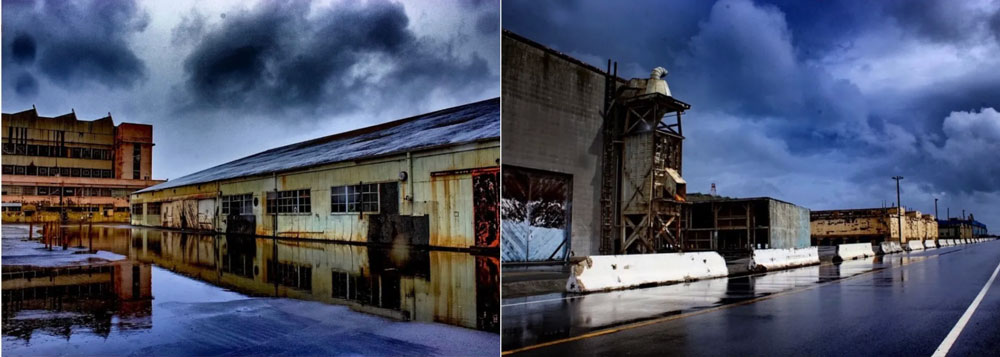
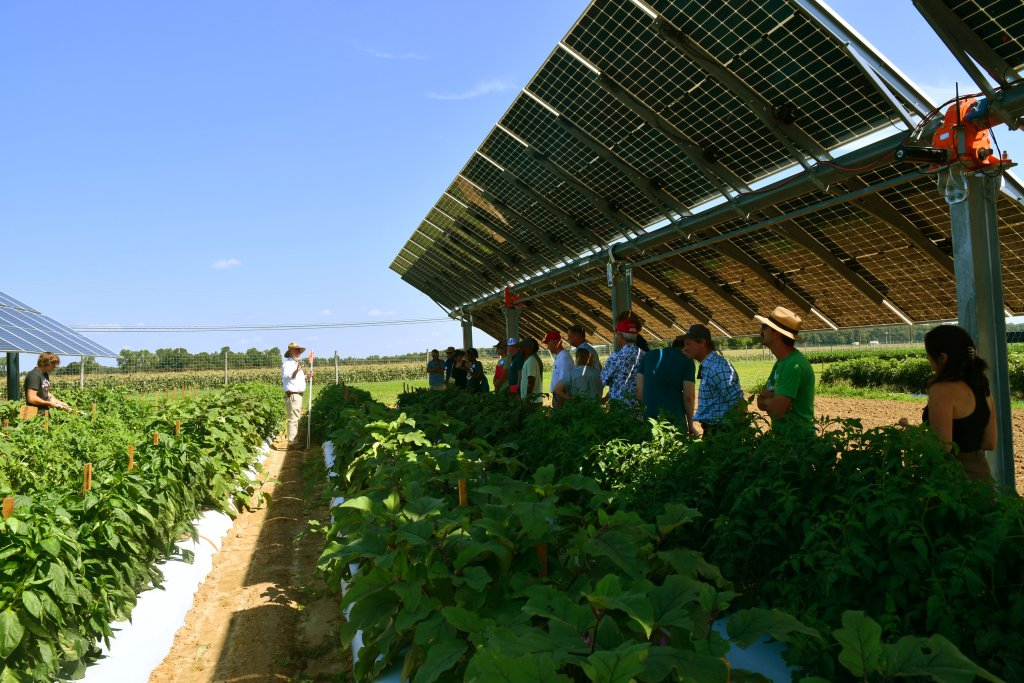
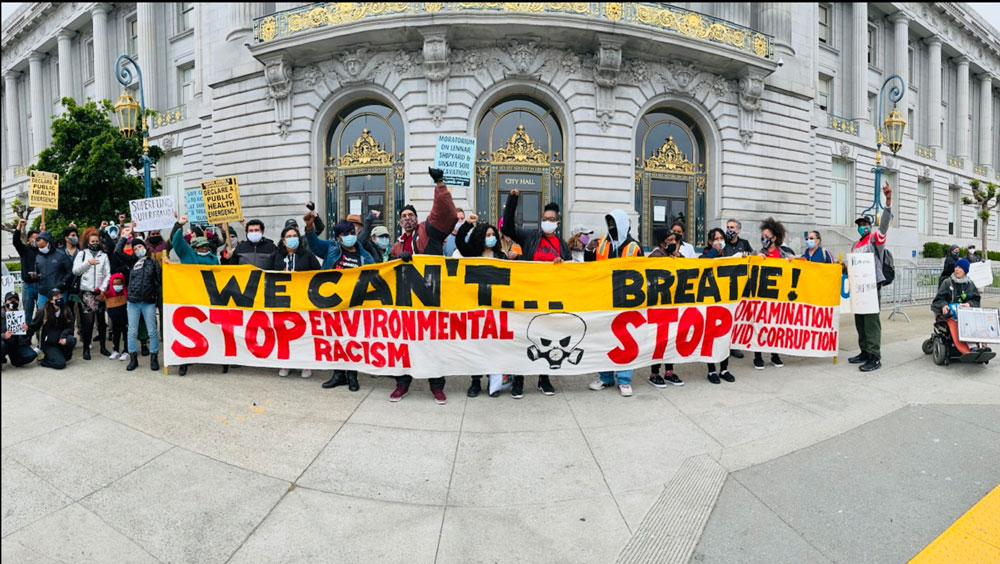
The photo above was taken from the western fence line of the Hunters Point Naval Shipyard overlooking Parcel G and the Gantry Crane, where demolition of MARSSIM Class 1 Radiation Contaminated Buildings is planned over the next six months.
The details, released May 31, 2025, about White House cuts to the EPA budget reinforces a saying I recall from my academic emergency medicine training…” They can always hurt you more!”
On May 3rd, Bloomberg Law reported the Trump administration was seeking $1 billion in cuts to EPA’s categorical grants program, projected to include $254 million in funding for Superfund clean up, $100 million for environmental justice, $90 million for Diesel Emissions Reduction Act grants and $100 million from EPA’s atmospheric protection program.
The San Francisco Bay Area is comprised of nine counties — 7.5 million people. EPA has managed a competitive grant program since 2008 to support projects to protect and restore San Francisco Bay’s wetlands and watersheds to reduce polluted runoff.
Flying under local media’s radar is a story by E&E News, posted on May 30, 2025, reporting that the White House FY2026 budget will cut the EPA’s watershed restoration programs by 83%…from $50 million yearly to $8.4 million.
Oxymoronically, the Make America Healthy Again Report released on May 16, 2025, establishes a Commission “to advise and assist the President on how best to exercise his authority to address the childhood chronic disease crisis…including the American diet, absorption of toxic materials and lifestyle and environmental factors.”
The Environmental Protection Network condemns massive cuts to EPA’s enforcement programs that will jeopardize public health and environmental protections, according to a Press Statement released on June 2, 2025.
The newly released FY2026 budget proposes a staggering 49% cut to EPA’s enforcement power, threatening to undermine the agency’s ability to uphold the nation’s environmental laws and protect public health.
“This unprecedented rollback would leave polluters unchecked, eliminate critical oversight and signal a dangerous abdication of EPA’s legal responsibility to ensure clean air, safe water, and healthy communities.” [https://www.environmentalprotectionnetwork.org/20260602_fy26-epa-budget_advisory/]

EPA verified evidence of falsification of radioactivity data submitted by Navy contractor Tetra Tech, and Parcel G was the site of extensive soil fraud. Indeed, EPA verified only 3% of Parcel G samples were not falsified!”
The question is, at what point do risks from a dangerous “clean up” of high-level nuclear waste outweigh the benefits of building homes on a Federal Superfund site?
The slashing of funding earmarked for EPA’s Superfund cleanup program will be sorely felt at the Hunters Point Naval Shipyard - one of 97 heavily contaminated Federal Superfund sites in California - that pose risks to human health and the environment and are a priority for federal cleanup efforts. An AI analysis shows health risks are most likely for residents living within a 1.8-mile radius of a Superfund site. In 2021, 20 out of the top 30 most polluted counties in the U.S. were in California.
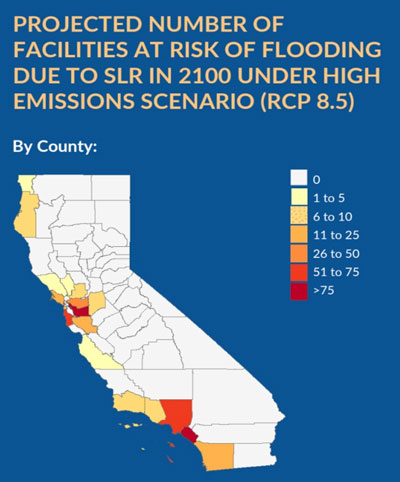
Sea level rise (SLR) threatens hundreds of toxic sites in California - many in the San Francisco Bay Area.
The Department of the Navy Base Realignment and Closure Program Management Office announced a $28.4 million award for contracts facilitating building demolition at HPNS on May 21, 2025. Six buildings on radioactive Parcel G (formerly designated Parcel E) will be demolished as authorized in fiscal year 2023 by the National Defense Authorization.
Building demolition is the process of dismantling, exploding, or knocking down building structures and materials used to construct the property.
A demolition plan outlining strategic steps taken to ensure the safety of the demolished structures without harming the environment or nearby residents and workers is required. As well as an environmental impact and human health hazard report. Two primary approaches to building demolition are structural dismantling and controlled implosion.
Explosives used in building implosion include nitrogen or high-velocity dynamite used to shatter reinforced concrete supports. Linear-shaped charges are used to sever steel supports. In a controlled demolition, building implosion involves the placement of high-velocity explosives like RDX, TNT, and Composition B, as well as low-velocity explosives like ammonium nitrate. RDX (Royal Demolition Explosive) is a powerful explosive used in military demolitions, as is Composition B - a military explosive composed of RDX and TNT.
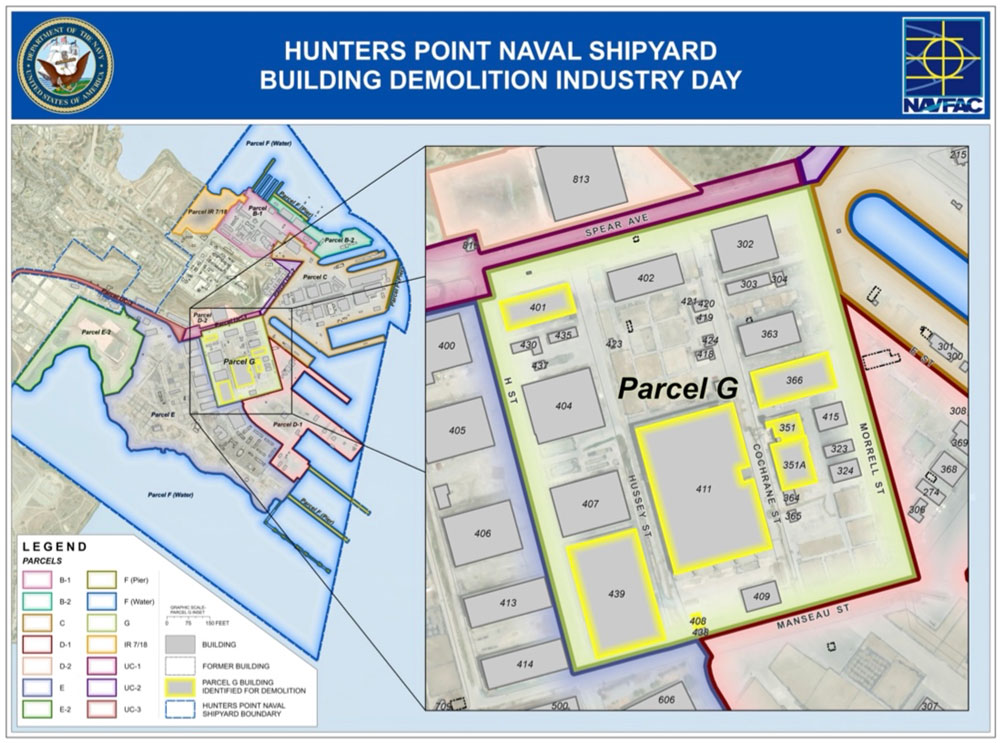
Hunters Point Naval Shipyard is a 40-acre, rectangular-shaped area within former Parcel D. It is slated for mixed-use residential development at its northern boundary with Spear Street under the 2010 Redevelopment Plan.
“The vast scope of the signs of falsification found is unprecedented nationally.” EPA Region IX - Regulatory Agency Interview Records - 2019
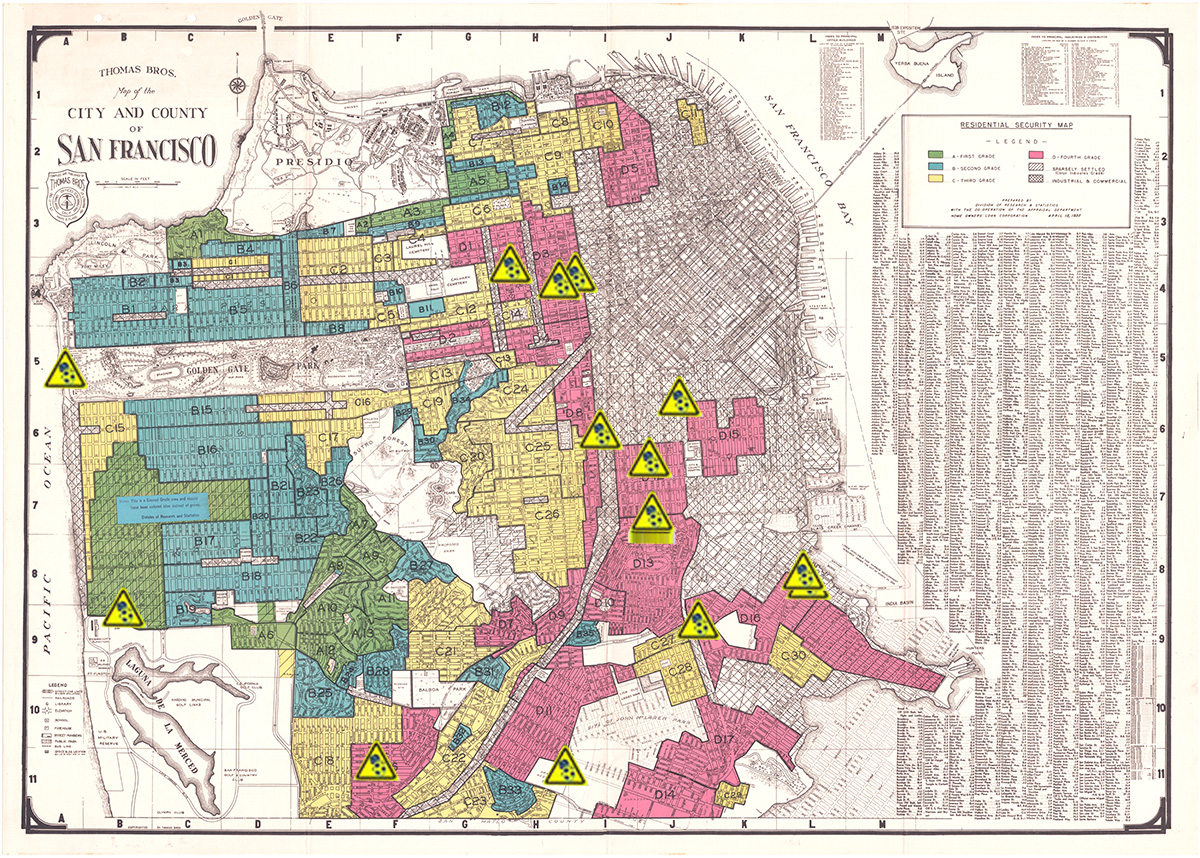
EPA verified evidence of falsification of radioactivity data submitted by Navy contractor Tetra Tech, and Parcel G was the site of extensive soil fraud. Indeed, EPA verified only 3% of Parcel G samples were not falsified! The Navy’s work plan to reevaluate and remediate that fraud centers on Parcel G: Basewide Impaction Map - Hunters Point Biomonitoring Foundation
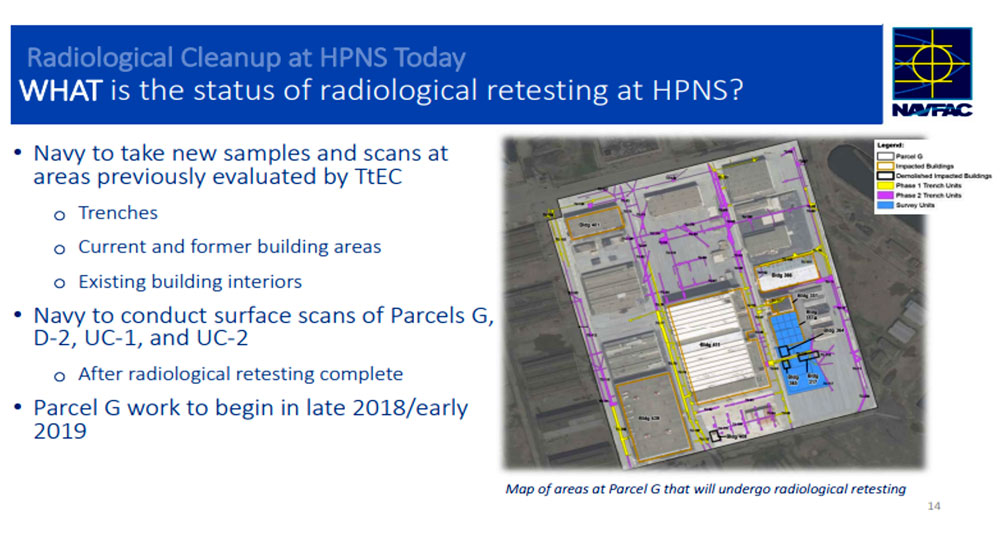
All six buildings slated for demolition are located on Parcel G, where a mixed-use residential development is proposed. Parcel G is a rectangular region directly behind the historic Hunters Point Gantry Crane on the Gun Mole Pier. Radioactive buildings scheduled for demolition include those shaded in green on Tetra Tech’s 2005 Basewide Impaction Map.
Buildings 351, 351A, 366 and 411 are designated Multi-Agency Radiation Survey and Site Investigation Manual (MARSSIM) Class 1 Radiation Impacted. Building 439 is not designated impacted on this early map. Still, it sits at the boundary of heavily contaminated Parcel E. Indeed, Building 439 is immediately adjacent to Building 606, where San Francisco Police Officers were sited and, in February 2025, filed an appeal of a wrongful death class action suit before the United States Supreme Court.
The Navy’s Parcel G Building Demolition website lists environmental considerations such as lead-based paint, asbestos-containing material, and PCBs in fixtures. The site does not list plans for radiological soil disposals, does not include a required demolition plan, EIR, or human health risk assessment, and offers contractors no recommendations regarding the use of protective gear to prevent radiation exposures.
Strontium-90 in concentrations exceeding remediation goals was detected in 10 locations on Parcel G - according to Press Statements issued by the Navy and San Francisco Department of Public Health in October 2021. The Navy’s soil cleanup goals for Strontium-90 are 69 times weaker than EPA’s adopted 2021 standards. Using EPA soil cleanup standards, the risk of exposure to soils released under Navy standards means one in every 473 residents or workers exposed to HPNS radiation-contaminated soils will get cancer. Watch the YouTube video Toxic Land to understand the cancer risks faced by a heroic shipyard worker and his family who died of a rare lymphoma in 2016.

In 2020, the U.S. Department of Energy announced it had reached agreement with the Department of Toxic Substances Control to demolish 10 of its 18 remaining buildings at the Santa Susana Field Laboratory to facilitate the delayed cleanup of the site. The demolition of buildings that comprised the DOE’s Radioactive Materials Handling Complex, generated above ground debris, low level radioactive waste for disposal…and public outrage!
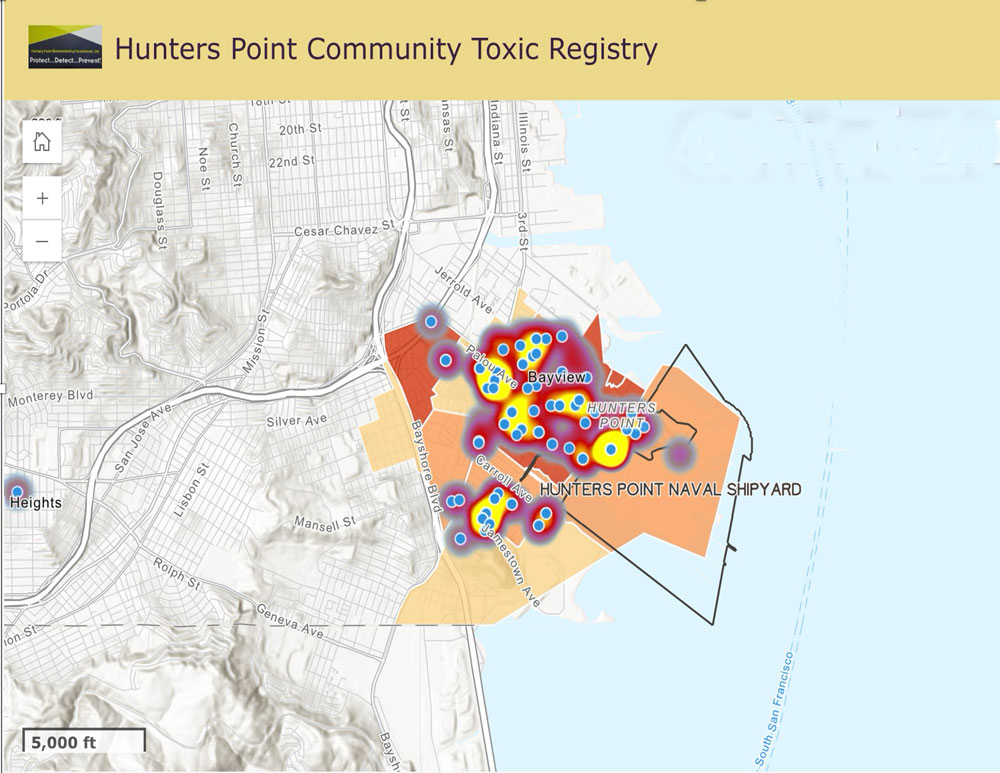
Hunters Point Biomonitoring’s Radiogenic Cancer Cluster at the Hunters Point Naval Shipyard - verification pending by the Greater Bay Area Cancer Registry
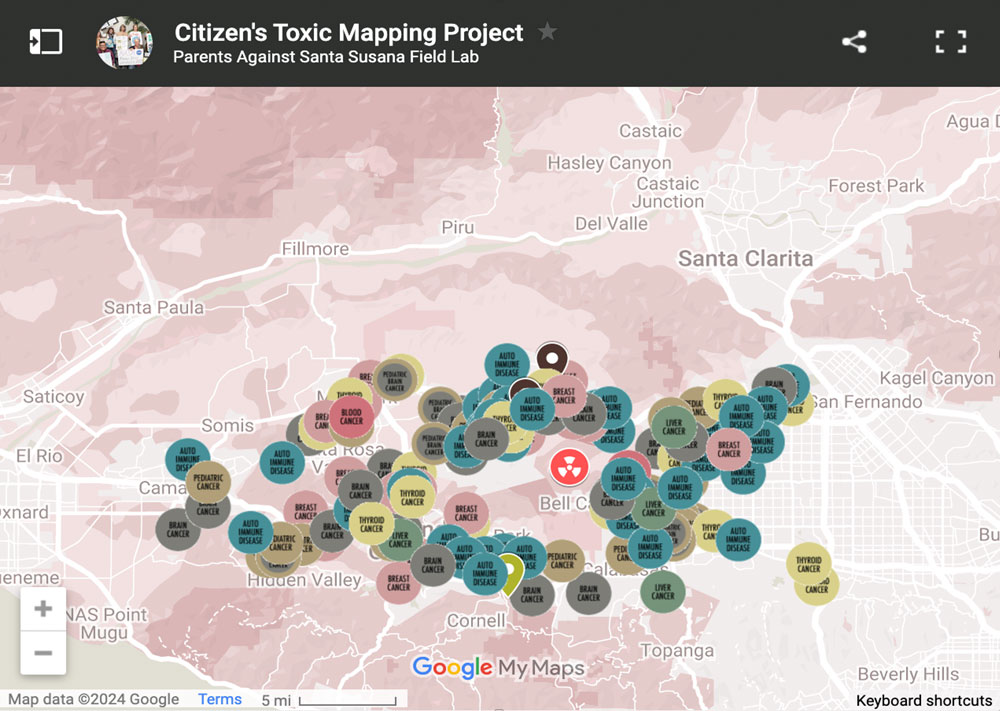
Santa Susana Field Lab is the SoCal site of a partial nuclear meltdown and numerous radioactive and toxic chemical releases. On October 1, 2021, the State allowed the U.S. Department of Energy (DOE) to dynamite two radioactive buildings - without required dust control - to prevent the spread of radioactive contamination at a site 30 miles from downtown LA.
Without permits from local authorities, DOE dynamited two buildings classified by EPA as MARSSIM Class 1 - the highest potential for radiation contamination - producing plumes of uncontrolled radioactive dust. MARSSIM provides information on planning, conducting, evaluating, and documenting buildings and soil that are radiation-contaminated. Published in August 2000 by the Nuclear Regulatory Commission, MARSSIM Class 1 areas, by definition, are impacted areas where residual activity exceeds release criteria. Parcel G buildings, soil and media slated for demolition at the Hunters Point Naval Shipyard are classified MARSSIM 1.
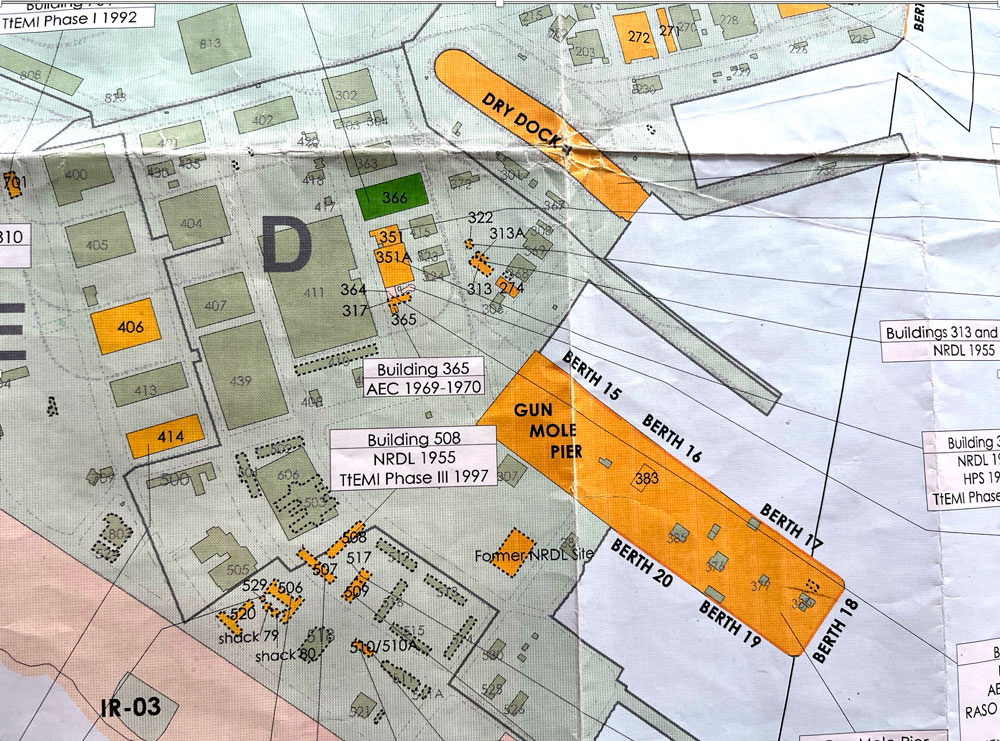
Hunters Point Naval Shipyard Basewide Impaction Map - Historical Radiological Survey 2000 - MARSSIM Class 1 radiation-contaminated buildings and structures are highlighted in orange, and heavily contaminated landfills and buildings are designated dark green. Buildings on Parcel G slated for demolition classified by the HRA as radiation-impacted include 351, 351A, and heavily contaminated building 366. Building 411 is designated MARSSIM Class 1 in the 2005 Tetra Tech base-wide radiological map on display in HP Biomonitoring’s research center.
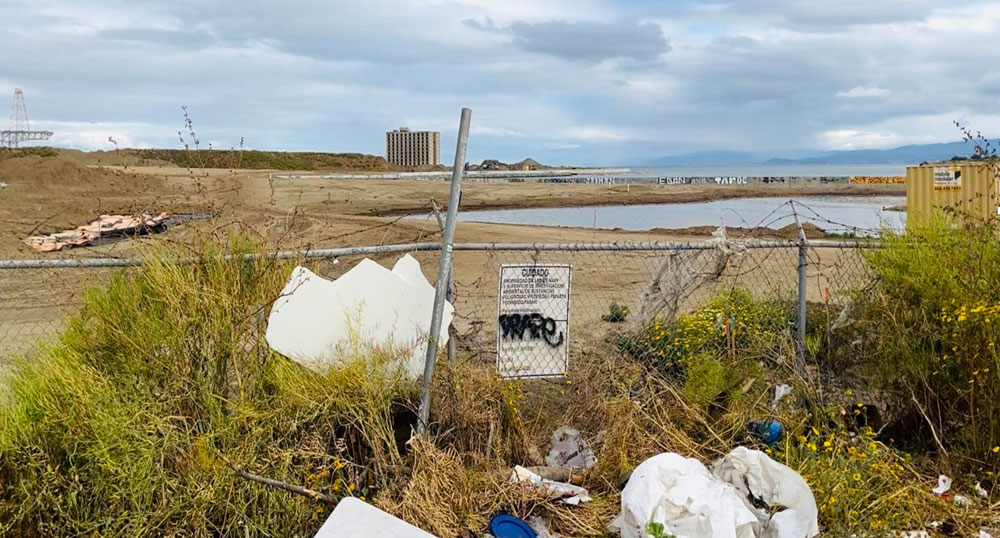
Photo above is of the unfortified chain metal fence at the western boundary of the Parcel E-2 industrial landfill taken by AP Sumchai on 09/22/2022 at Fitch Street and Shafter Avenue. Parcel G is less than a mile east of a fence line lacking dust barriers. The historic Hunters Point Gantry Crane is seen in the top left of the photo. The Gantry Crane is a landmark for Parcel G, where the Navy will demolish six radiologically impacted buildings over the next six months.
“Be afraid…be very afraid!”
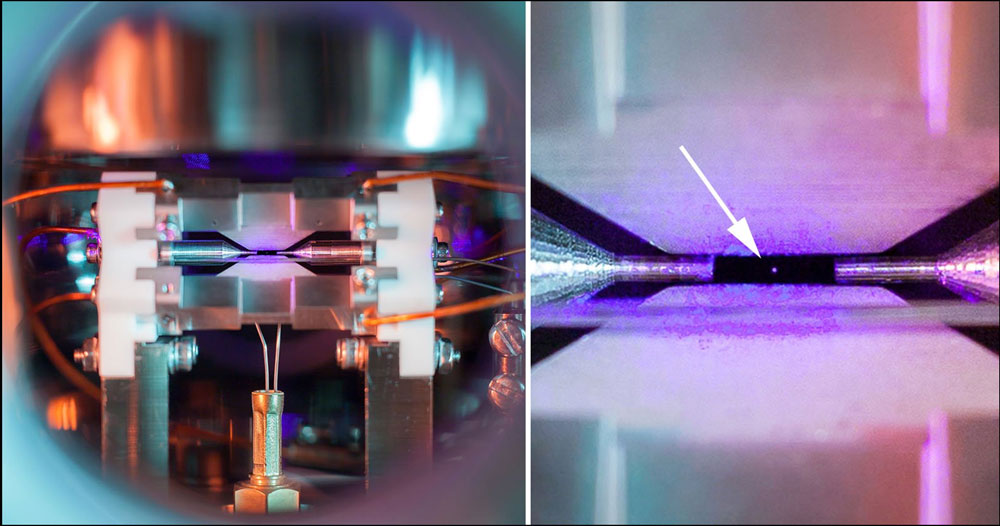
A photo of a single strontium atom won the UK’s Engineering and Physical Sciences Research Council photo competition in 2018. Taken by David Nadlinger of the University of Oxford. Titled “Single Atom in an Ion Trap,” the photo depicts a single positively charged strontium atom held by electrical fields generated by metal electrodes, captured through the window of the ultra-high vacuum chamber housing the ion trap.
Strontium is a silvery, alkaline metal that is highly reactive. In its naturally occurring state, it is not radioactive. Strontium has radioactive isotopes. You are probably aware of Strontium - 90. Produced in nuclear reactors, Sr-90 is a beta emitter with a half-life of 29 years. Radioactive Strontium is chemically similar to calcium and is absorbed by bone leading to health problems…including cancer.
On October 21, 2021, the San Francisco Department of Public Health issued a Statement notifying the public that the Navy, while analyzing soil samples at Parcel G, identified the detection of radioactive Strontium in concentrations above health-based cleanup goals: Of note, the Press release includes the utterly asinine quote: “The Navy has stated the levels of Strontium-90 detected to date do not indicate a risk to human health or the environment.”
According to the Statement issued by the Navy, 10% of Parcel G samples detected Strontium-90 in concentrations exceeding health-based remediation goals. According to Committee to Bridge the Gap, both Strontium-90 and Plutonium - 239 were detected in concentrations 40 to 60 times higher than background in the Navy’s Parcel F Feasibility Study.
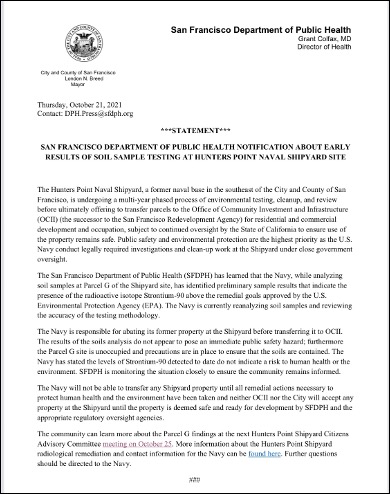
The detection of radioactive Strontium on Parcel G in concentrations exceeding health-based cleanup goals amplifies and justifies concerns about the use of explosive detonations to demolish buildings at a Federal Superfund site with one of the highest EPA-assigned Hazard Ranking Scores on the National Priorities list.
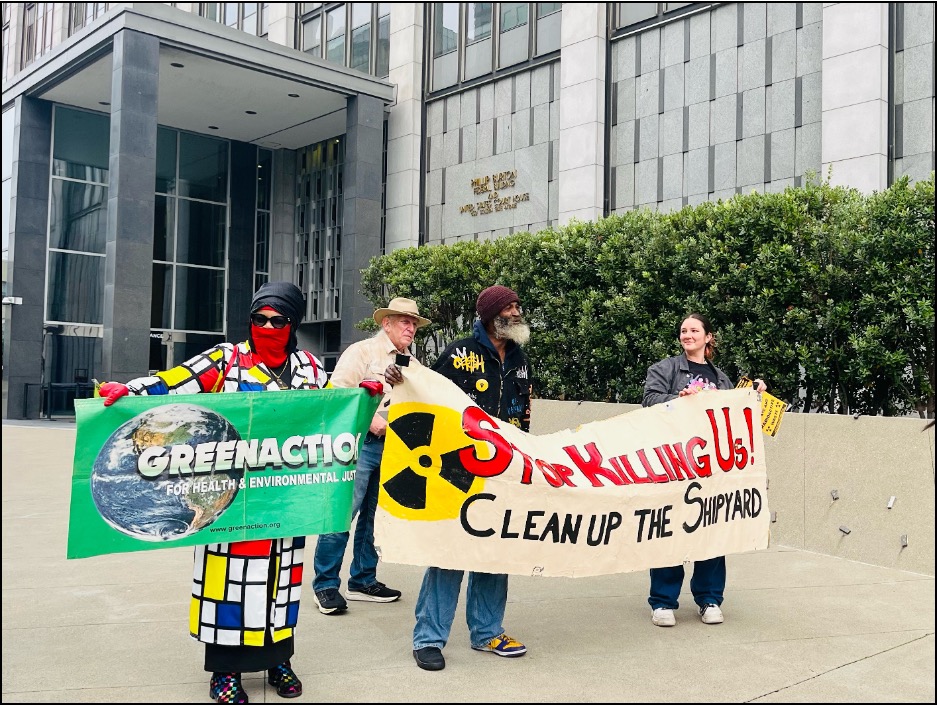
Photo: Greenaction Earth Day 2021 - BVHP Local Emergency Community Declaration
“Whereas the Hunters Point Bayview Community wishes the Hunters Point Shipyard to be cleaned to a level that would enable the unrestricted use of the property - the highest standard for cleanup established by the United States Environmental Protection Agency.” SF Board of Supervisors Adopts Prop P as Official City & County Policy - 2001
The people of San Francisco must stand in solidarity with the Bayview Hunters Point community to…
- Demand full disclosure, transparency, and release of the HPNS Demolition Plan for six radiologically impacted buildings slated for demolition by the U.S. Navy
- Demand full disclosure, transparency, and release of environmental impact and human health risk reports for a planned demolition within a mile of residential Parcel A-1 and South Central BVHP.
- Demand full disclosure, transparency, and release of dust control plans and chain metal fence fortifications for the demolition of radioactive buildings, soils and groundwater on a Federal Superfund site.
- Demand full disclosure, transparency and public release of plans for disposal of low level radioactive waste.
Dr. Ahimsa Porter Sumchai is an environmental activist and Community Healer/UCSF Alumni living on the Westside.
June 2025