San Francisco Governance Overhaul: Task Force Moves to Eliminate 60 Boards and Expand Mayoral Power
Participatory Government at Risk? Streamlining Task Force Sends Sweeping Commission Cuts to Supervisors

Monette-Shaw
After reviewing 152 boards and commissions, the voter-created task force recommends eliminating 60 bodies and restructuring dozens more, sparking debate over public oversight and mayoral authority.
• • • • • • • • • • March 2026 • • • • • • • • • •
The Commission Streamlining Task Force, created by voters with “Proposition E” in November 2024, has wrapped up most of its work and will now meet quarterly, if necessary, until it’s disbanded in January 2027.
Late-Breaking Update: Urgent Action Needed
Board President Rafael Mandelman — is violating the “30-Day Rule” to rush through commission reform on behalf of the Mayor.
The Commission Reform Task Force’s “Final Report” and proposed legislation are being rushed, depriving members of the public adequate time for thoughtful review, reflection, and analysis.
The materials include the 134-page recommendations on streamlining reform of boards, commissions, and advisory bodies, and two pieces of related legislation — the proposed 166-page Charter Amendment language for the November 2026 election, and an initial 308-page City Ordinance that would go into effect 90 days later.
San Franciscans must now turn to advocating with the Board of Supervisors urging them to reject many of the recommendations made in the Task Force’s final report — before San Francisco’s participatory democracy dies in darkness.
Please sign (and share) this petition (CLICK HERE). Please share this petition widely with your contacts.
San Franciscans can oppose this bait-and-switch by contacting the Board of Supervisors at bos@sfgov.org or board.of.supervisors
@sfgov.org, and referencing Board Files #260225 and #260147. A sample letter of objection can be found on-line here, which has been submitted to the Board of Supervisors.
Task Force Completes Year-Long Review of City Commissions
The Task Force transmitted its 134-page “Final Report,” accompanied by a 1,086-page “Supplemental Appendices” document, to the Board of Supervisors for consideration after unanimous approval from the Streamlining Task Force on January 28.
Overall, of the 152 bodies the Task Force assessed, it recommended keeping 86 boards, commissions, and advisory bodies; eliminating 60 bodies; combining two bodies with either another body or City staff; and making no recommendation on the remaining four bodies, leaving that to the discretion of the Mayor and the Board of Supervisors.
Critics argue that the “Final Report” glosses over the complexities and challenges of its deliberations, sidestepping critical analysis of its decision-making process.
As well, the final versions of the Task Force’s 166-page Charter Amendment and the 308-page first-planned Ordinance were forwarded to the Board of Supervisors, reportedly on February 27, prior to the March 1 deadline.
Public Testimony and Opposition
During its year-long meetings, the Task Force took testimony from 572 public speakers at 18 meetings and received written letters and petition signatures from 824 San Franciscans, almost all of whom opposed preliminary decisions the Streamlining Task Force was making as it went along.
This widespread opposition from 1,396 San Franciscans was disregarded, highlighting a disconnect between the Task Force and public sentiment.
Questions Raised About Task Force Membership
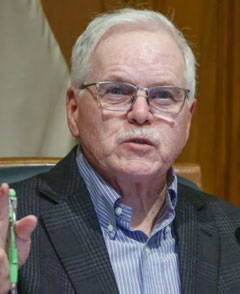
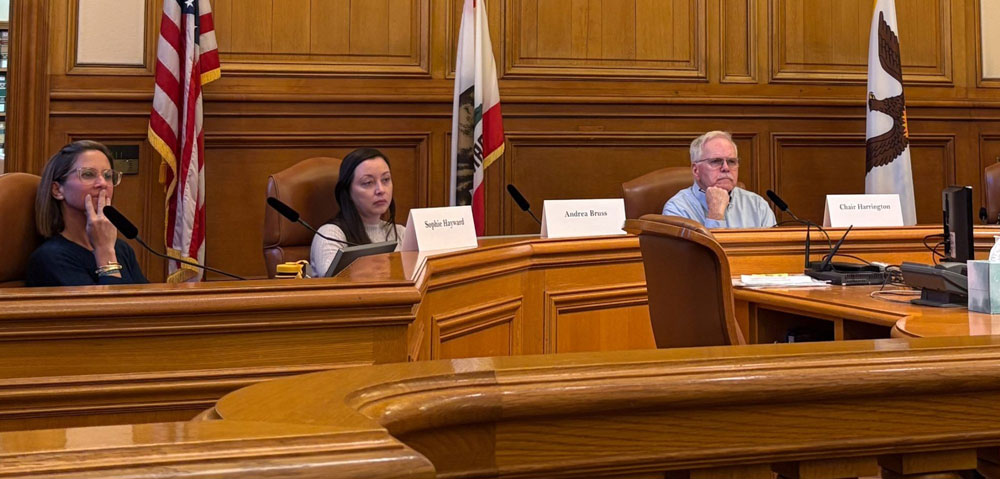
Photo courtesy SF Examiner
Could it be that, in part, Task Chair Ed Harrington is improperly occupying Task Force Seat 4, which requires an organized public-sector labor union representative; Harrington lacks the required qualifications? Similarly, Task Force member Sophia Kittler occupies Seat 5, reserved for an Open Government expert; Kittler similarly has no such qualifications in open and accountable government. Kittler’s education and expertise are in private sector development. As Mayor Lurie’s Budget Director, Kittler’s experience is in public-sector government budgeting, not in open government.
Task Force Vice Chair Andrea True (née Bruss) was rushed to appointment as “Director of Government Legal Reform” in the City Attorney’s Office on January 4, 2025 — but not in a legal job classification code. That “director” position appears to have been newly created for Bruss as a golden parachute from Mayor Breed’s administration. It was a new position created in January 2025 that hadn’t existed before. Bruss had previously been Breed’s Deputy Chief of Staff, and legislative aide to Supervisor Cohen.
All three were appointed without the required membership qualifications, undermining the validity of all its decisions.
Allegations of Political Influence
In addition, both Harrington and the inaugural Vice Chair of the Streamlining Task Force, Jean Fraser, the Director of the Presidio Trust until recently, are listed as Board Members of SPUR.
Public testimony often noted that the Task Force was taking orders from SPUR, the current Executive Director of which is former District 7 Supervisor Sean Elsbernd.
Voters will likely be reminded that the Task Force’s wrongful actions were carried out by people who were clearly not qualified for their roles but were political appointees.
What Happens Next at the Board of Supervisors
Now that the Streamlining Task Force has submitted its final report and proposed legislation to the Board of Supervisors, San Franciscans will likely advocate with the Board of Supervisors to reject many of the Task Force’s recommendations.
Streamliner’s Zero Savings
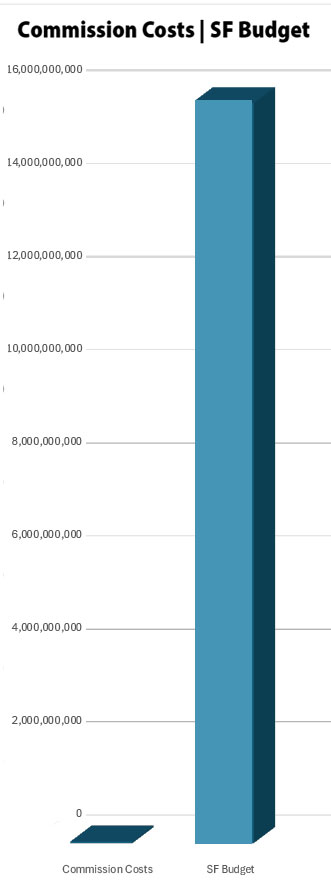
A key component of “Proposition E” on the November 2024 ballot required a cost analysis of the City’s boards and commissions to be prepared and submitted by September 1, 2025. The Board of Supervisors Budget and Legislative Analysts’ report documented that 112 boards and commissions cost a combined $33.9 million annually, but didn’t assess the costs of the 40 other bodies at all.
A separate Westside Observer Cost Savings Analysis reveals that, of the 86 bodies the Streamlining Task Force has recommended be kept, there will still be $31.2 million in annual costs associated with them, fully 92.2% of the total costs.
At best, the actual savings to the City’s annual budget might approach a mere $105,482, as described below —a scant 0.00066% — yes, just sixty-six ten-thousandths of one percent — from the City’s current $15.9 billion budget.
Sixty Boards and Advisory Bodies Recommended for Elimination
Of the 152 boards, the Streamlining Task Force identified 31 inactive bodies, another 5 bodies borderline inactive, and two more bodies were discovered and deemed inactive. That totaled 38 inactive bodies, but the Task Force recommended keeping one of them and eliminating the remaining 37.
During a body-by-body review of the remaining 114 bodies, the Task Force decided to eliminate an additional 23.
Ultimately, the Streamlining Task Force recommended eliminating 60 bodies, listed here alphabetically, along with their estimated savings.
In reality, the probable savings total just $105,482 or 0.314% — yes, just three-tenths of one percent — of the total $33.9 million. The $105,482 in actual savings would be from full-time “hard costs” by eliminating the 60 bodies. The overwhelming $2.3 million cost balance for the 60 bodies won’t materialize because it’s for part-time City employees. These “soft costs” will likely keep their jobs to continue performing their other job duties.
The 60 bodies recommended for elimination include:
- Adult Day Health Care Planning Council, Advisory Council on Human Rights
- Bicycle Advisory Committee
- Board of Examiners
- Citizens Committee on Community Development
- City Agency Task Force (Lead Abatement)
- Early Childhood Community Oversight and Advisory Committee
- Food Security Task Force Housing Stability Fund Oversight Board
- Local Homeless Coordinating Board
- Long Term Care Coordinating Council
- Our Children Our Families Council
- Public Works Commission
- Sanitation and Streets Commission
- SFMTA Bond Oversight Committee
- Shelter Monitoring Committee
- Treasure Island/Yerba Buena Island Citizens Advisory Board
- Urban Forestry Council, among others.
Three of the 60 bodies identified for elimination by the Task Force are “voter-approved bodies” created by voter-approved City Ordinances — including the “Dignity Fund Service Providers Working Group,” “Our City Our Home Oversight Committee,” and the “Street Artists and Craftsmen Advisory Committee.”
The three voter-approved Ordinance bodies being eliminated yield no savings in the City's full-time staff “hard costs.” In addition, two others have sunset dates, so they may not be reauthorized by the Board of Supervisors.
Structural Changes to Remaining Commissions
In addition to the 60 bodies being eliminated, an additional 16 bodies are having a date-specific “sunset” date applied when they are moved from the City Charter into the Administrative Code, so those 16 bodies will soon face having to defend their ongoing retention and re-certification from the Board of Supervisors during the next three years.
If the Board of Supervisors eliminates the 60 bodies, and eventually allows the 16 bodies to sunset, that will reach a total of 76 boards, commissions, and policy bodies that will vanish — just as the backers and proponents of “Proposition D” had proposed during the November 2024 election, proving wet dreams can come true.
Streamlining the Task Force’s Decision-Making
Although Streamlining Task Force Chair Harrington had cautioned the Task Force against dramatically altering the City’s commission structure, because ‘Proposition E’ was about streamlining, not radically overhauling public governance the Task Force drastically altered the City’s Boards and Commissions, mirroring exactly what the backers and proponents of “Proposition D” had set out to do. Instead of facilitating “Prop. E” reforms, the Streamlining Task Force ultimately delivered “Prop. D, ”which the voters rejected.
Structural Changes to Remaining Commissions
Of the surviving 86 bodies, the Task Force recommended changing the structure of 69 and modifying the responsibilities of at least 28. And the 86 bodies were drastically altered in several ways.
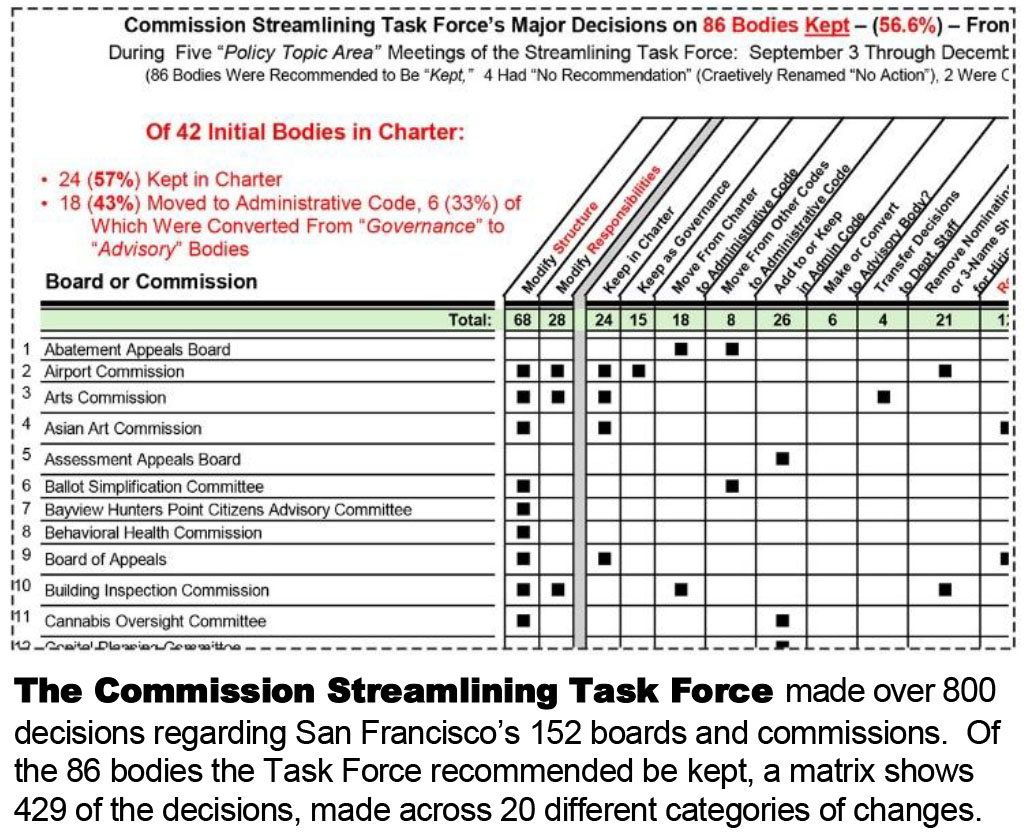
Through its year-long deliberations, a Major Decisions Matrix the Westside Observer has compiled (from the final 40-page Decision Log and meeting minutes) a 20-item breakdown of the major decisions affecting the 86 bodies recommended to be kept. Each row in the matrix analysis shows the multiple decisions for each of the recommended 86 bodies.
The 20 categories of decisions included:
• keep in charter
• keep as a governance body
• move from the City charter to the Administrative Code
• move from other codes to the Administrative Code
• add to or keep in the Admin Code
• make or convert to an advisory body
• transfer decisions to department staff
• remove nominating ability for three-name candidate short list for hiring department heads
• retain department head hiring and firing authority
• remove department head hiring and firing authority
• continue serving at-will
• change from for-cause removal to at-will removal of body members by their appointing authority
• retain budget approval
• remove budget and contract authority
• don’t apply a sunset date
• apply three-year sunset date
• remove recall of body members by voters
• remove member seat-level qualifications
• update member seat qualifications or make “desirable” body-level
• and remove body-level qualifications.
Unfortunately, it’s difficult to summarize or report on how those structures and responsibilities are being modified, in part because of the sloppy way the Task Force conducted its meetings, and the bewildering onslaught of its 3,725 pages of documents, along with the blizzard of 3,209 pages of revision documents. That totals at least 6,934 pages that the Task Force produced. The Westside Observer has read nearly all of them!
Among the worst of changes the Streamlining Task Force made that are presented in our major decisions matrix analysis, the Task Force recommended:
18 bodies be moved from the City Charter to the Administrative Code.
- Building Inspection Commission
- Citizens’ General Obligation Bond Oversight Committee
- Commission on the Environment
- Commission on the Status of Women
- Disability and Aging Services Commission
- Entertainment Commission
- Human Rights Commission
- Park, Recreation, & Open Space Advisory Committee (PROSAC)
- SFMTA Citizens’ Advisory Council
- Sheriff’s Department Oversight Board
- Small Business Commission, among others.
This was driven by SPUR’s insistence that there were too many bodies in the City Charter. But the real reason for moving them into the Administrative Code is to make it easier, over time, to eliminate these boards and commissions that the Task Force concluded were “inefficient” and impediments.
Vice Chair Jean Fraser (before her sudden resignation mid-stream a week later) claimed that memorializing and enshrining bodies in the Charter prevents elected officials from modernizing and updating them as needed, rapidly and nimbly as the City’s needs change over time.
As well, Task Force member Sophie Hayward asserted moving bodies to the Administrative Code with sunset dates would allow for a structured “off-ramp” — code words for making it easier for the Supervisors to deny extending the life of any board or committee — to forcibly prompt periodic reevaluation.
25 bodies have their Member Qualifications changed or eliminated, or made merely “desirable.”
- Airport Commission
- Arts Commission
- Ballot Simplification Committee
- Building Inspection Commission
- Citizens’ General Obligation Bond Oversight Committee
- Disability and Aging Services Commission, Elections Commission
- Ethics Commission
- Family Violence Council
- Health Service Board
- Police Commission
- Public Utilities Commission
- Recreation and Parks Commission
- SFMTA Citizens' Advisory Council
- and the Sunshine Ordinance Task Force, among others.
Removing requirements for specific, relevant credentials, experience, and training as criteria for appointment to technical or specialty public oversight bodies will likely lower the quality of decisions made by these oversight bodies. For example, removing specific membership skills from the Building Inspection Commission could cause the building inspection codes to suffer dangerously.
There was no real reason to alter seat qualifications for bodies such as the Ballot Simplification Committee, the Sunshine Ordinance Task Force, the Ethics Commission, or any of the other 22 bodies. The Task Force alleged that so-called “seat-level” qualifications made it more difficult for appointing authorities to fill vacancies — even though almost all bodies always had a full contingent of appointed board members, and recruitment to fill vacancies was time-consuming.
And whether for reducing the remaining qualifications to merely “desirable” qualifications opens the door to political patronage.
The Task Force alleged that qualifications to serve on some boards and commissions are thirty years old and should be updated to reflect the City’s “current reality.” The Task Force assumes that the drafters of the enabling legislation could not possibly have set membership qualifications that would pass the test of time.
With qualifications reduced to merely “desirable,” appointments to some boards and commissions require no experience or qualifications to serve at all. Perhaps that was another of SPUR’s end games. What could possibly go wrong?
This will politicize appointments to civilian oversight bodies.
26 bodies have their Department Head hiring and firing authority removed.
- Arts Commission
- Building Inspection Commission
- Children and Families First Commission
- Commission on the Environment
- Commission on the Status of Women
- Entertainment Commission
- Fire Commission
- Health Commission
- Human Rights Commission
- Planning Commission
- Police Commission
- Port Commission
- Public Utilities Commission
- Recreation and Parks Commission, among others.
This change has long been one of SPUR’s top goals.
Initially, the Task Force claimed teach body would retain a “consultative role only” in the hiring and firing decisions. That appears to have been a smokescreen to quell public commenters from opposing the changes in the early stages of the Task Force’s deliberations.
At the very end of the hearings as they were finalizing their “Final Report” — perhaps at the urging of SPUR — the Task Force suddenly changed the rules to allow the Mayor to make all hiring and firing decisions, to skip consulting with the respective Boards and Commissions, and do so only if he chooses to consult beforehand.
This will give the Mayor a stronger “strong mayor” form of government. And it will weaken each department’s independence.
24 bodies be changed from “For-Cause” to “At-Will” member removal.
- Airport Commission
- Asian Art Commission
- Behavioral Health Commission
- Commission on the Status of Women
- Disability and Aging Services Commission
- Elections Commission
- Entertainment Commission
- Health Commission
- Human Services Commission
- Planning Commission
- Police Commission
- Port Commission
- Public Utilities Commission
- Small Business Commission, among others.
Changing to “at-will” removals will also politicize the appointment. It eliminates independence, reducing agencies to political tools rather than expert, neutral administrators. It undermines long-term, non-partisan, and, in some cases, constitutional decision-making. For-cause restrictions (allowing removal only for “inefficiency, neglect of duty, or malfeasance”) were designed to ensure agencies operate based on expertise, rather than the whims of political pressure. And converting to “at-will” removal of board and commission members can easily lead to further corruption by allowing a member’s appointing authority to remove a member for even a single vote or decision that the appointing authority doesn’t like.
Report Raises Questions About Decision-Making Process
The 134-page “Final Report” is accompanied by a 1,086-page “Supplemental Appendices” document. Both documents were transmitted to the Board of Supervisors for consideration.
Opponents alledge he Final Report reads like a masterclass in whitewashing — gaslighting San Franciscans.
A summary of questionable assumptions in the “Final Report” includes:
- The Executive Summary states on page iv that the Task Force’s recommendations will “improve accountability” by updating board and commission responsibilities through “shifting some responsibility to the Mayor” for hiring and firing City Department Heads — a key goal of SPUR’s “Charter for Change” issued on November 10, before the Task Force concluded its review of boards and commissions. Did SPUR’s report sway the Task Force’s deliberations?
In reality, the Westside Observer’s matrix of major decisions made for the 86 bodies it recommended be kept indicates that 26 (30.2%) of the 86 bodies will have their authority over department heading hiring and firing removed, 21 (24.4%) of the 86 will have their ability to nominate and submit three-name short lists for potential department head candidates eliminated, and just 12 (14%) will retain their authority over department head hiring and firing decisions.
This isn’t merely shifting authority. It hands the Mayor, plain and simple, increased “strong mayor” powers over the hiring and firing of almost all City Department Heads. - Page 2 asserts “Proposition E” had “established a Task Force of experts in City management” to lead the “streamlining” work. As noted above, three of the appointees to two of the Streamlining Task Force seats — Ed Harrington, Sophia Kittler (and Jean Fraser, before Kittler) — did not meet the seat-level qualifications for appointment. It’s disputed whether the remaining three members are qualified to be called “experts.”
- Page 2 also asserts that the Board of Supervisors can decide whether to place the recommended Charter Amendment on the November ballot, and that the initial Ordinance will automatically take effect 90 days after introduction to the Board of Supervisors unless two-thirds (8 of the 11) Supervisors vote to amend it.
The Report fails to mention that the Board of Supervisors has the authority and ability to “duplicate” each proposed piece of legislation and make any number of changes to either duplicate. - In the section on Membership Qualifications (page 7), the Task Force addresses only “body-level” qualifications in the “current state of the City’s commission system.” The report asserts that “narrowly defined” body-level qualifications can make it difficult to recruit and fill appointments, leading to persistent vacancies. The report fails to quantify or even summarize the vacancy rates on any of the boards and commissions. Missing in the “current state of affairs” section is any description of “seat-level” qualifications and why they are valuable.
- Regarding removal of board and commission members, the report notes on page 8 that voters can recall appointed members of four bodies — the Airport, Ethics, Port, and Public Utilities commissions — in the “current state of the City’s commission system,” but it doesn’t mention or discuss why voters were given that authority.
Three of the commissions, excluding the Ethics Commission, oversee vast “enterprise agency” City departments responsible for massive City infrastructure and City contracts. San Franciscans need and want democratic oversight of the four Commissions. Recall of regulatory body members is a safety valve in the event that commissioners fail to act in the public’s best interest, allowing citizens to hold officials accountable if they fail to represent constituent interests. The recall mechanism provides a direct democratic check against potential corruption and incompetence.
Why did the Task Force decide the voter recall protections were within the Task Force’s “streamlining” mandate? The Westside Observer had to point out to the Streamlining Task Force during its last meeting on January 28th that its “Decision Log” had identified the removal of the recall provision for only three of the four commissions. The Public Utilities Commission had not been listed as removing the recall feature. It was only minutes before the Task Force took its vote to adopt its “Final Report” that the City Attorney quickly added in the PUC at the last minute, just before their vote, since the five-member Task Force had not noticed it was missing during earlier meetings reviewing drafts of its “Final Report.”
Of more interest, although it was mentioned on page 8 of its report as being part of the City’s current system, recall of members of those four commissions is not mentioned anywhere else in the “Final Report” until page 108, in “Appendix D,” the “Record of Task Force Member Votes.” The Task Force chose to bury this decision in the errata of its decision-making, perhaps hoping voters wouldn’t notice. - The Streamlining Task Force made a deliberate decision to whitewash and “scrub” the word “templates” — and its reliance on templates used during their decision-making processes that began in earnest on September 3 — from its “Final Report.”
The Task Force had labored over developing a “Governance Body,” “Advisory Committee,” and “Regulatory Boards” templates they voted on and approved during their July and August meetings, at the insistence of their inaugural Vice Chair, Jean Fraser, one of the two SPUR Board members appointed to the Task Force. Throughout their five main body-by-body deliberation meetings between September 3 and November 19, the Task Force routinely voted on various motions on individual decisions specifically citing “align to templates.”
Indeed, their “Decision Log” reveals that of the 800-plus decisions it made, 191 were listed as “template alignment,” including 21 bodies that were “aligned” to the final naming convention adopted for bodies. In addition, another 11 bodies that had initially been forced into template alignment or the naming convention were subsequently overturned and superseded.
That stands in contrast to the 46 “template” exceptions granted exemptions, allowing the 46 bodies to continue as they had before.
In fact, during the Task Force’s November 19 meeting — after having followed strict adherence to the early, uniform templates during its five policy topic area body-by-body decision meetings had concluded — the meeting minutes report Task Force member Kittler had “mused that the Task Force’s templates have been useful as a decision-making framework but may not be helpful as a messaging tool going forward.” That’s when the Task Force started covering its tracks about its reliance on templates and began referring to them in late January as merely “standards.” Thankfully, we know this to be whitewashing by any other name, because none of the Task Force’s meeting minutes for all of their meetings during 2025 ever referred to “standards.” They were consistently referred to as “templates.” But in the Final Report, the “templates” were creatively dumb-downed and rebranded as “standards.”
The Task Force used these templates to evaluate bodies throughout its decision-making meetings, but now wants us to believe — via gaslighting — that it had shifted to more tailored, non-template-based, or case-by-case decisions. It now expects us to not believe our own lying eyes that it had all along engaged in strict adherence to the early, uniform templates to guide its decisions between September 3 and November 5, when it considered the last 23 bodies in its “General Administration and Finance” major policy category of bodies. Why do they feel compelled to now cover this up?
According to the Task Force’s January 14, 2026 meeting minutes, member Sophie Hayward noted that the second version of the draft “Final Report” presented for the Task Force’s consideration also did not reflect all the Task Force’s decisions accounted for in its “Decision Log.”
Indeed, mirroring Ms. Hayward’s concerns, according to one Google search AI overview, concerns have been raised by community observers the Streamlining Task Force's “Decision Log” does not fully reflect all actions, specifically regarding how functions of bodies are being transferred, or where they are being absorbed, and the Task Force has sometimes made decisions without a full, transparent analysis of how the functions of one body are being “absorbed” by another body in a chainsaw approach.
The BLA’s “Financial Analysis” PowerPoint presentation had specifically warned that the Task Force should carefully analyze and document how any given body’s functions would be protected and sustained by another body. The AI overview describes the process as removing commissions from the City Charter and moving them into the Administrative Code to make future “housecleaning” easier, a process critics suggest has not been fully documented in the Task Force’s “Decision Log.”
Finally, as part of its cover-up, the Task Force deliberately decided to exclude either it’s 40-page “Decision Log” or the Budget and Legislative Analyst’s 38-page “Financial Analysis” report in the 1,086 “Supplemental Appendices” report to the Board of Supervisors to help with documenting the historical record of their deliberations. They did so, asserting:
“The decision log and BLA report were not originally intended for inclusion due to their redundancy with report content and lack of relevance for decision-making, respectively; they could be added to the supplemental appendices if the Task Force preferred.”
It’s laughable that the Task Force decided its own “Decision Log” was redundant, when in fact it served as the basis to document in granular detail the decisions it had made that are not fully explained or even mentioned in the final report! But of course, the “Decision Log” did include the incriminating evidence that 202 of its 800-plus decisions had been made to “align with templates.” And the admission the BLA’s “Financial Analysis” report lacked relevance to the Task Force’s decision-making is a sad reminder of just how inept this Task Force had been.
In the end, the Task Force voted to provide only hyperlinks to the documents online rather than transmit them for retention at the Public Library—perhaps counting on the fact that, over time, the hyperlinks would break and no longer function.
The Westside Observer plans to address some of the Streamlining Task Force’s most egregious recommendations and other problems in our next issue.
Monette-Shaw is a columnist for San Francisco’s Westside Observer newspaper, and a member of the California First Amendment Coalition (FAC) and the ACLU. He operates stopLHHdownsize.com. Contact him at monette-shaw@westsideobserver.com.
March 2026